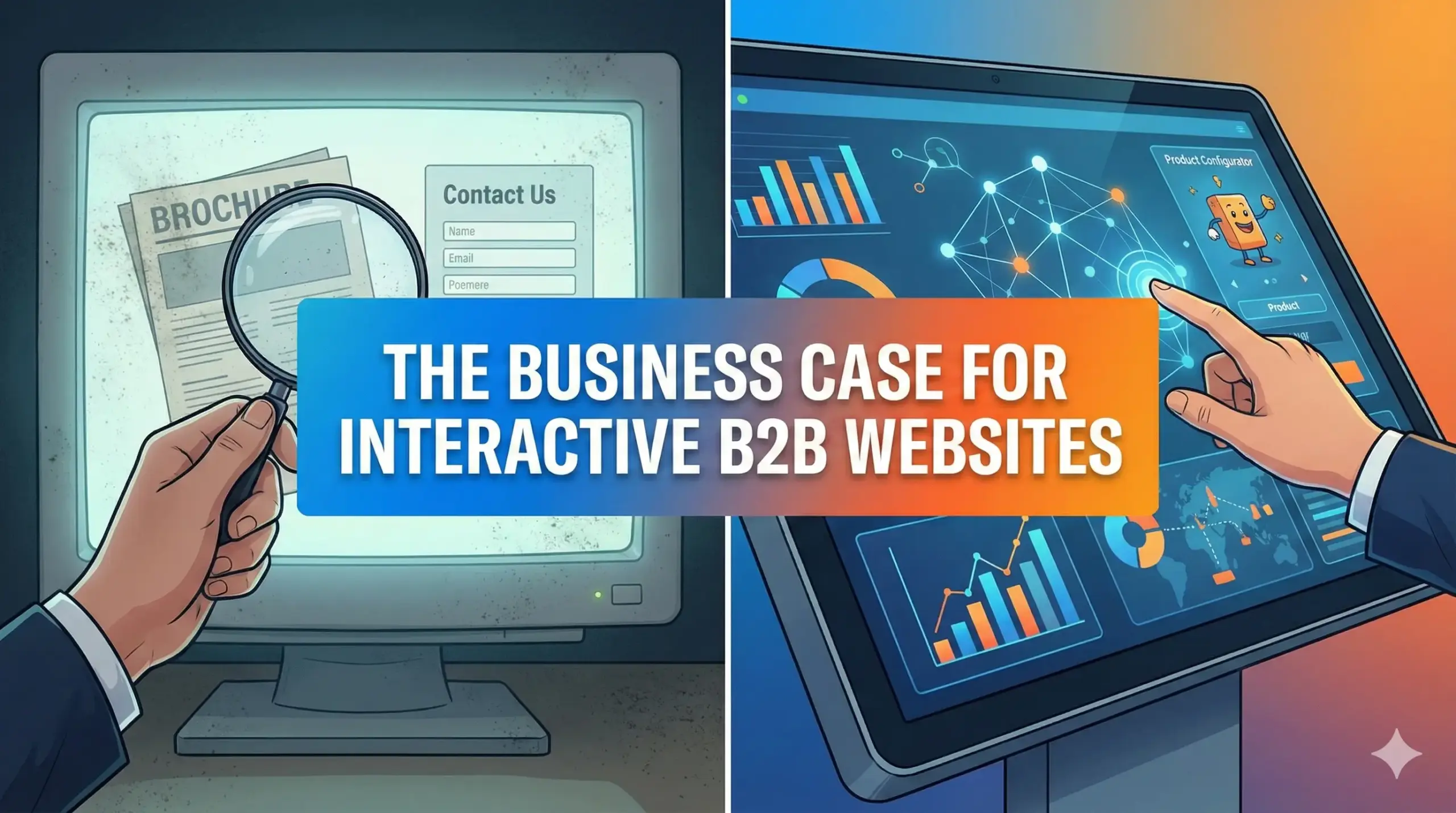

The Business Case for Interactive B2B Websites
For decades, the standard B2B website was a digital brochure: a static repository of “About Us” pages, executive bios, and downloadable PDF whitepapers. In that era, the website’s job was simply to drive a phone call. The real selling happened person-to-person.
That era is over. Today, B2B buyers are digital-first. They expect the same fluid, self-driven experiences they encounter in their consumer lives. They do not want to “Contact Sales” just to understand if a product fits their infrastructure; they want to find out for themselves. This shift has turned the company website from a passive brochure into an active, 24/7 sales engine.
Building an interactive website isn’t just a design choice; it is a critical business strategy. Here is the in-depth business case for why your B2B platform needs to evolve, backed by real-world examples from industry giants like Tata Communications.

The “Self-Service” Buyer Reality
The modern B2B buyer is autonomous. According to Gartner, B2B buyers spend only 17% of their purchase journey meeting with potential suppliers. The remaining 83% is spent researching independently. If your website cannot answer their complex questions through interactive exploration, they will move to a competitor who can.
Static content fails here because it forces the user to read linearly. Interactive content—like solution configurators, ROI calculators, and dynamic roadmaps—allows the user to navigate non-linearly, finding the exact information relevant to their specific pain points without wading through irrelevant marketing fluff.
Case Study: Tata Communications
One of the strongest examples of this shift is Tata Communications. As a global digital ecosystem enabler, their portfolio is incredibly complex, spanning network connectivity, cloud security, IoT, and media services. A static list of services would be overwhelming and ineffective.
Instead, Tata Communications utilizes a highly interactive website strategy that serves as a “digital consultant” for the visitor. Here is how they do it:
1. The “Solution Finder” Approach
Rather than dumping all products on a single page, Tata’s website often guides users through a “By Need” vs. “By Business Type” filtering system. This interactive segmentation allows a CIO looking for “Cloud Security” to see a completely different view of the company than a Media Executive looking for “Live Video Streaming” services. The website adapts to the user, not the other way around.
2. Interactive Simulation & “Digital Twin” Concepts
In their more advanced sectors, such as 6G and IoT, simply describing a network isn’t enough. Tata Communications has leveraged concepts like virtual simulations and interactive network maps. These tools allow potential enterprise clients to “visualize” connectivity reach and latency reduction before they sign a contract. By making the intangible (bandwidth and speed) tangible through interactive visuals, they significantly de-risk the purchase decision for the buyer.

Beyond Tata: IBM’s Narrative Demos
IBM is another giant mastering this space. For products like IBM Instana, they use “scenario-based” interactive demos. Instead of just showing buttons, they walk the user through a day in the life of a DevOps engineer (often a character like “Serena”). This storytelling approach engages the user emotionally while demonstrating technical capability.
The ROI of Interactivity: Why It Pays Off
Investing in these features requires budget and development time, but the business case for the Return on Investment (ROI) is clear.
- Increased Dwell Time (SEO Gold): When a user plays with a pricing calculator or a network map, they stay on the page for minutes, not seconds. Google interprets this “dwell time” as a signal of high quality, boosting your search rankings.
- Higher Quality Leads: An interactive website acts as a filter. By the time a prospect contacts your sales team, they have already educated themselves on your pricing tiers and solution fit. They are not just “browsing”—they are ready to buy.
- Trust Through Transparency: B2B solutions are often accused of being “black boxes.” Interactive demos strip away the mystery. Showing exactly how a dashboard works or how a service integrates builds immediate trust.
Conclusion
The lesson from leaders like Tata Communications and IBM is simple: complexity requires clarity. As B2B products become more technical, static text becomes less effective. To win market share in 2025 and beyond, businesses must treat their website as their best, most interactive salesperson. It is time to move beyond the digital brochure and build a digital experience.

